Venetian plaster vs paint in a Miami home: what each really costs over ten years
Paint is the cheapest way to finish a wall, and on day one nothing beats it. In Miami, though, a painted wall rarely stays untouched for long: humidity, air conditioning and everyday scuffs put it back on the repaint list every few years. Venetian plaster costs more upfront and has no repaint cycle. Here is an honest way to compare the two over ten years, including the rooms where we would still choose paint.
The short answer: cheap today, or cheap to live with
Paint is the cheapest way to finish a wall, and on the day the painter leaves, nothing beats it. Venetian plaster costs several times more to put on. If that were the whole story, there would be nothing to compare.
The real comparison is over the years you live with the wall. In a Miami home, a painted wall in a busy room usually goes back on the list every three to five years: scuffs, a touch-up that shows, a bathroom wall that blistered. Venetian plaster has no repaint cycle. It is cleaned, a chip is patched, and the protective layer in wet rooms is refreshed now and then.
Our honest summary: on a plain wall in a quiet room, paint usually stays cheaper in pure dollars, even after ten years. Plaster closes the gap, and often makes more sense, on the walls that get touched, scuffed, steamed and looked at: the entry, hallways, the powder room, the fireplace and the main wall of the living room.
Day one: what each finish costs per square foot
Typical Venetian plaster prices in Miami for 2026, per square foot of wall: mineral plaster with a concrete effect $15–20, marmorino $15–25, polished Venetian plaster $20–30, and special finishes such as metallic, gold leaf or relief from $30. These prices include surface preparation, materials, hand application and the protective sealer. Projects with M5 start at $10,000, and you get one fixed price in writing after a free site visit.
We do not quote painting, so we will not put a number on it here. Ask a painter for a quote that covers what a repaint really involves: patching, priming where needed, two coats, moving and covering furniture. It will be a fraction of the plaster price, and that is fair. Paint is a thin film rolled or sprayed on. Venetian plaster is several thin coats, troweled and burnished by hand, with drying time between them.
What you are really deciding is whether that hand labor pays you back over the next ten years. Everything that moves the plaster number is in What Venetian plaster costs in Miami.
Ten years in Miami: the repaint cycle
Paint does not fail in Miami, but it works hard. Humid air and an air conditioner that runs all day, or is switched off while the owners travel, put stress on the paint film. Bathroom walls blister where steam gets trapped behind it. Hallways, entries and the wall behind the sofa collect scuffs from shoes, luggage, chairs and children. That is why many owners repaint busy rooms every three to five years, which means two or three repaints in ten years.
Each repaint is more than the painter's invoice. Furniture is moved, floors and fittings are covered, and the rooms are out of use and smell of paint for a while. In many Miami condo buildings, any crew that comes in needs a certificate of insurance and an elevator booking, painters included. Our condo renovation guide covers those building rules.
Plaster is not maintenance-free either. Here is how the ten years compare:
| Venetian plaster | Paint | |
|---|---|---|
| Day one | Higher: from $15–20 per sq ft for mineral plaster to $20–30 for polished Venetian; projects from $10,000 | The lowest of any wall finish |
| Ten years in a busy room | No repaint cycle | Usually two or three repaints |
| A scuff or a chip | Buffed out, or patched and blended by the master | Touch-ups often show, so the whole wall is repainted |
| Humid rooms | No film to blister or peel; wet zones are sealed | The film can blister and peel where moisture is trapped |
| Upkeep | A damp cloth; the sealer in wet rooms is refreshed now and then | Washable paints clean up, but wear shows over time |
| Changing the color | A new finish, a real job | Easy and inexpensive |
Repairs: a patch, not a repainted wall
This is where the ten-year math moves most. Touch up a painted wall and the patch often shows: the sheen is slightly different, the color has shifted with age, and the light from a window finds the edge. So a small mark usually ends with the whole wall repainted, corner to corner.
Venetian plaster is repaired differently. Light scuffs buff out. A deeper scratch or a chip is filled by the master with the same material and blended into the surrounding finish, and it does not show the way a touched-up painted wall does. A hairline crack, if the building moves, is filled and refinished the same way. It is a short visit, not a project.
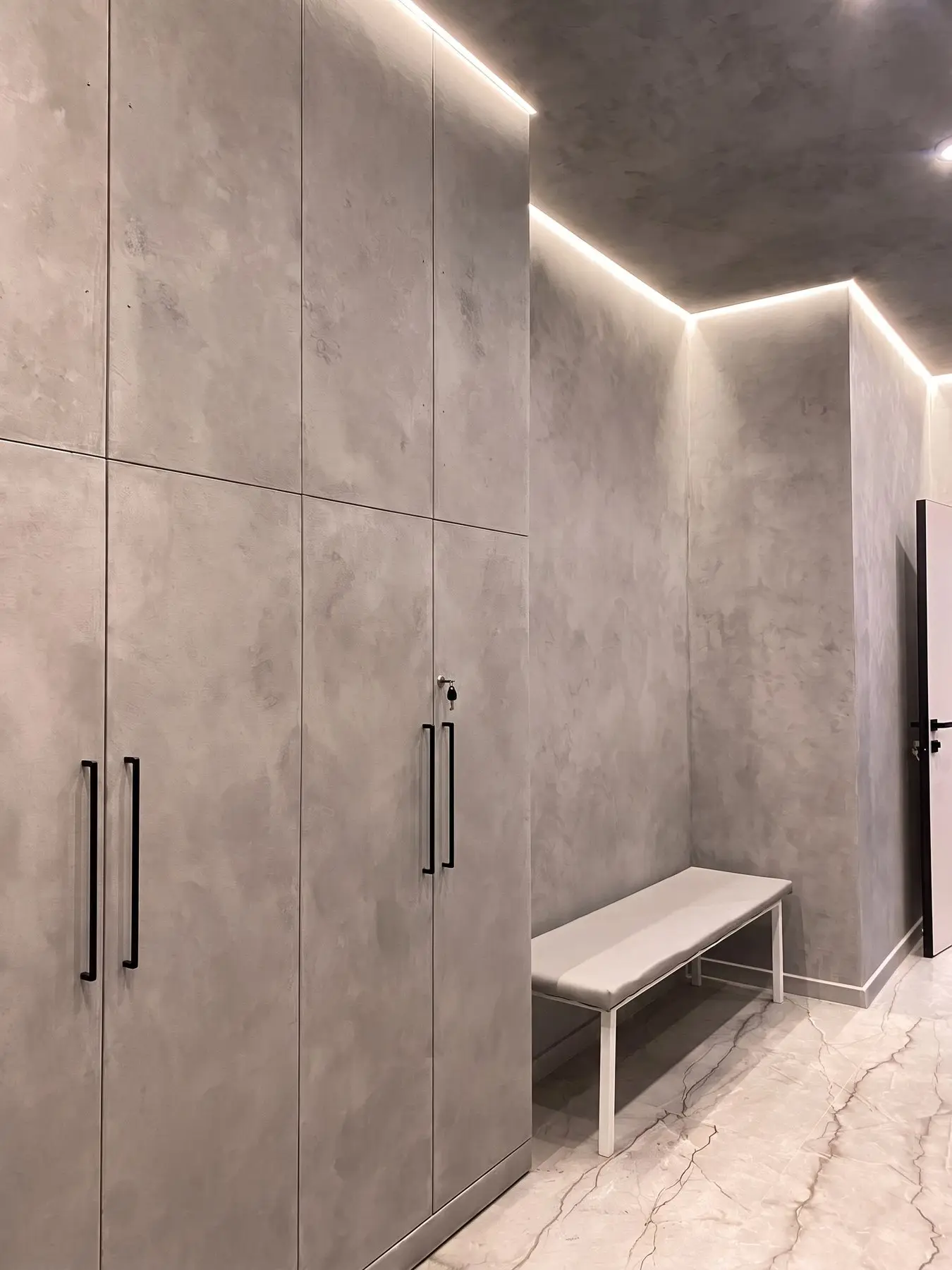
Hallways and entries are where the comparison tips toward plaster first: they take the most knocks, and a guest sees them first.
Humidity: a film versus a mineral surface
Paint is a film. When moisture gets behind it, in a bathroom without a good exhaust fan for example, the film blisters and peels, and the fix is to scrape and repaint. Venetian plaster, marmorino and mineral plaster are mineral finishes with no film on top. Water vapor passes through instead of being trapped, so there is nothing to lift.
The caveat is the one we give in every bathroom: breathable is not waterproof. Walls outside the shower are fine with a protective sealer and a working fan, and inside the spray, tile or stone is often the better choice. That sealer belongs in the plaster's ten-year cost, because it wears slowly where water hits it most and is refreshed from time to time. The full picture, including salt air and mold, is in Venetian plaster in Miami humidity.
Where paint is still the better choice
We apply Venetian plaster for a living, and we still suggest paint for some rooms. Paint is the better choice when:
- You like to change colors. If a room gets a new color every few years, like a child's room as the child grows, paint does that cheaply. Recoloring plaster means a new finish.
- The home is a rental or will be sold soon. Between tenants, a fresh coat of paint is the normal reset, and a buyer will choose their own colors.
- The ceiling is an ordinary one. Plaster can run onto the ceiling without a break, which suits a powder room. In a standard bedroom, a flat painted ceiling does the job.
- Closets, laundry and utility spaces. Nobody looks at them long enough for plaster to pay back.
- The whole job is small. Projects with M5 start at $10,000. A single small wall may not reach that, so plaster usually makes sense as a room, a hallway or a set of feature walls.
The usual answer in a Miami home is a mix: Venetian plaster where the wall is touched and seen, paint everywhere else. A feature wall with a hidden door is a good example of plaster used where it matters.
How to run the numbers for your home
Put the two sides next to each other for the rooms you are deciding on. For paint, take one full quote and multiply it by the number of times the room will be painted in ten years, the first coat included, then add the time those rooms are out of use. For Venetian plaster, take one fixed price and add refreshing the sealer in wet rooms and the occasional patch. Then add the part that does not fit in a spreadsheet: how the wall looks in the evening light, and whether you want to look at it every day.
The plaster side is easy to pin down. Send us a photo of your wall on WhatsApp, and we make a real hand-made sample of the finish you like. A master then visits for free, holds the samples against your wall in your own light, checks the surface and the humidity, and you get one fixed price in writing. Browse finished walls in our plaster work or the sample library first, and if the wall is part of a larger project, see condo and apartment renovation.
Questions
Is Venetian plaster cheaper than paint over ten years?
Not always in pure dollars. On a plain wall in a quiet room, paint usually stays cheaper even after two or three repaints. Plaster closes the gap on walls that get scuffed, steamed or repainted often, such as entries, hallways and powder rooms, because it has no repaint cycle and damage is patched instead of the whole wall being repainted.
How often do walls need repainting in Miami?
Busy rooms such as hallways, entries and bathrooms are often repainted every three to five years, because of scuffs, humidity and touch-ups that show. Quiet rooms can go longer. Venetian plaster is not on a repaint schedule: it is cleaned, patched where needed, and wet zones get their protective layer refreshed.
How much does Venetian plaster cost per square foot compared with paint?
Typical Miami prices for 2026 are $15–20 per sq ft for mineral plaster, $15–25 for marmorino, $20–30 for polished Venetian plaster and from $30 for special finishes, including preparation, materials and the protective sealer. Paint costs a fraction of that upfront. Projects with M5 start at $10,000, with one fixed written price after a free site visit.
Can I change the color of Venetian plaster later?
Yes, but it is a new finish rather than a quick repaint, which is why we confirm the color on a real hand-made sample before work starts. If you expect to change colors often, paint is the better choice for that room.
Does Venetian plaster need maintenance?
Very little. Clean it with a soft damp cloth and a little mild soap, with no abrasive pads or bleach-based cleaners. Light scuffs buff out, and a chip is patched and blended by the master. In wet rooms the protective layer wears slowly and is refreshed from time to time.